
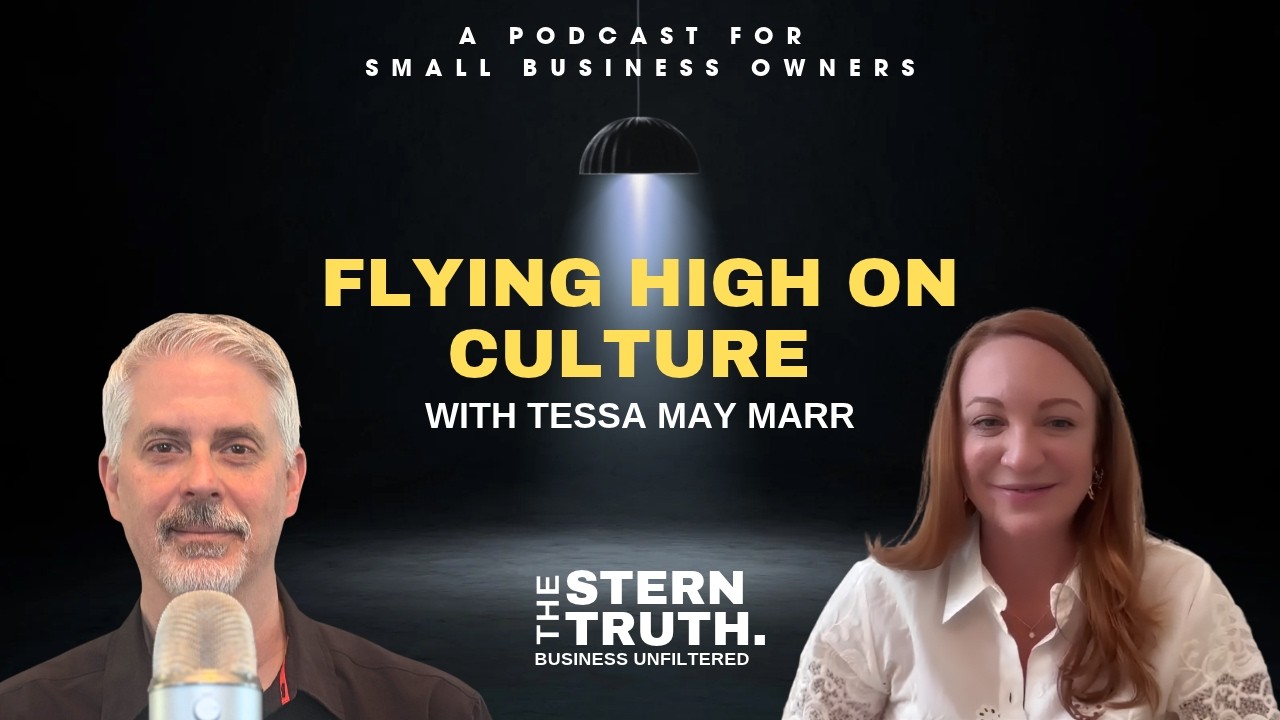
What actually builds a strong company culture when your team never shares an office?
When Marshall Stern had me on Episode 99 of The Stern Truth: Business Unfiltered, that was the question we kept circling back to. My short answer: it isn't the perks. It's how you treat people, every single day, plus a simple system that keeps everyone rowing in the same direction. Our team is spread across Canada and the US, we just became Great Place to Work Certified, and honestly, I cry at work at least once or twice a week. Those three things are more connected than they sound.
I took a job with WestJet at 19 and stayed for 14 years. I loved seeing the world, and the schedule gave me time to get curious about the business side. By my mid-twenties I was working in the office on cross-functional teams (projects where people from different departments work together), picking up project management along the way.
Then, in 2012, I noticed something in Calgary. Our mayor at the time, Naheed Nenshi, was all over Twitter, talking with people directly. Every politician does that now. Back then it was new, and I watched how differently I felt about brands that actually replied to me rather than the ones that ignored me. Meanwhile, most business owners I talked to brushed social off completely. One literally asked me why anyone would invest in social media when there's print.
So I tested it myself. I'd just gone gluten-free, so I started a Twitter account called Gluten-Free Calgary. Two years later it was a community of 30,000 people, and I realized I'd built a business by accident that made no money. I added a subscription, sold it, and started Marr Media Group in 2014.
Years ago, when I was younger and working in that office, I got emotional about something. Not angry, just upset, because I cared. My boss pulled me aside and told me I needed to keep that in check. I understood where he was coming from. But as I grew, I knew I didn't want to build a place where you can't cry at work.
When someone on my team gets emotional about their work, I'm grateful. It means they care that much. That's something to make room for, not something to manage away.
I call it the whole human approach. You don't leave your life at the door when you log on. If you're going through a breakup or dealing with a health issue, of course that's affecting your work. There's no world where it isn't. So I'd rather my team feel safe saying so and asking for what they need. Sometimes the only support someone needs is to hear "that sucks, and I'm here if you need me." It doesn't mean the work stops. It means people feel seen.
I've managed that way for years, and now our managers manage that way too, each with their own style. That's how it spreads. We don't share an office, but when we get together once or twice a year, people are literally fighting over who gets to share a room. I just sent out my wedding invitations and invited the whole team. They think it's hilarious. I think it's the point. 🤍
And we have fun. We're not saving lives here, and we spend a lot of our time together. Let's laugh.
I never got into business wanting to manage people. What I didn't expect is that the people would be the most rewarding part of the last 12 years.
I believe in hiring the best people and getting out of their way. I recently replaced myself as Director of Client Services, and wow, did we level up. My goal is to keep making myself irrelevant in the day-to-day so I can focus on what I'm actually good at.
Here's what that looks like in real life. A couple of times a week, someone messages me asking if I can "do the thing" where I help them see the forest through the trees. Just yesterday, someone asked if I could help talk them off a ledge. We jumped on a quick call. That's my job now: give people the resources, the encouragement, and the perspective to do their best work.
Casey is a great example. She's been with me for over 11 years and now leads our whole Creative Team. She learned how to lead by watching how we do things, put her own spin on it, and honestly, she's better at it than I am. That's how culture actually travels. Not through a handbook. Through people.
We run the company on the Entrepreneurial Operating System (EOS), a set of simple tools for setting goals, running meetings, and holding everyone accountable. Marshall pushed back on me here, in the best way. His point: a system is only as good as the people running it, and the heart of a business comes from its leaders, not its software.
I agree, and here's the thing. EOS has tools built specifically for people. One asks whether each person is in the right seat. Do they understand the role, do they genuinely want it, and do they have the time and skills to do it well? If the answer is no, it doesn't make them a bad person. Sometimes they belong here, just in a different seat.
We set EOS up ourselves in 2019, when it was me and four contractors. I remember asking if we could shorten the 90-minute weekly meeting because I didn't want to pay four people to sit with me that long. The answer was always "follow the process." I went a little rogue anyway, and I think that's what got us started. Today we almost never change a thing.
I love it so much that my partner and I now run a weekly check-in at home with our own personal goals. My personal goals started getting done so much faster that I wondered why I hadn't done it sooner.
If you're a team of one or two, you don't need the full meeting. Start with a one-page plan for where you're going and a short weekly list of the numbers that matter. We review our one-page plan every quarter and use it to make decisions, which brings me to the hardest one.
There's real power in growing with the clients you already have. Most business owners love the idea of landing a client and expanding what you do for them. But go too wide, and you stop being the expert.
A big reason we win business is that we're social-first. Plenty of agencies offer social, and when I talk to their owners, they'll admit they kind of do it on the side. Social is demanding. The algorithms change constantly, the content never stops, and the conversation happens in public. I always say I picked the most relentless industry to be in.
So every time someone on our leadership team brings a new idea, we ask one question: does it fit our niche? We're all about building social communities that convert, so a new service has to plug straight into social.
If an idea doesn't fit, we say no, even when it's revenue. And when a client needs something outside our lane, we'd rather refer them to someone great than do it halfway. Whether we manage a channel or not, we want every channel rowing in the same direction.
We were honestly a little slow to adopt AI. Our creatives had strong feelings about it, and I understood why. We didn't force it on anyone, but we did require everyone to explore it.
Here's what we learned. Content that's heavily built on AI is starting to push people away. Audiences can tell, and on social, where there's so much content competing for attention, that break in trust matters. Everything starts to sound the same.
So we just made a big investment in AI in a different place. We brought in an AI agency to automate 10 of our behind-the-scenes workflows, which they estimate will save us around 77 hours a month. All of it is systems. None of it is creative.
Marshall had a funny story about someone accusing one of his posts of being AI. I've had the same thing happen on LinkedIn. My team jokes that you can always tell I wrote mine because there's a spelling mistake somewhere, usually because I'm walking my dog while I write. And yes, I used to love an em dash. Now I'm rewriting everything.
Whatever you write, long or short, it only works with a strong hook. People decide in seconds whether to keep going. Long-form can be powerful storytelling, but only on platforms where people are there to read, like LinkedIn. Know your channel, know your audience, and test it.
Marshall asked for one golden nugget. I gave him three.
1: Start before you feel ready. You will never feel ready. That's true for starting a business, and it's true for every big decision inside one. Some of my team want everything buttoned up first. We figure it out as we go.
2: You're worth more than you're charging. About five years in, I doubled our prices. Not a single client blinked. I still coach our sales team on this: if you keep closing every deal, go get me a no. Good pricing has a little friction. Today we're doing seven times what we were doing when I first doubled.
3: If you believe in it, the right people will say yes. Don't be afraid to do things differently. When you know something will make a difference and you can sell it with real conviction, people find the budget.
This week, in your next one-on-one, skip the status update for the first five minutes. Ask "how are you, really?" and just listen. You'll learn more about what's slowing your team down than any dashboard will tell you, and they'll remember that you asked. What's one thing you've done that made your team feel seen?
Related Articles

This guide is a step-by-step blueprint for consumer product brands looking to turn their happiest customers into powerful brand affiliates. By leveraging social media, brands can create a cost-effective, high-converting affiliate program that generates organic word-of-mouth marketing.


